Home / Blog / How to read the aurora forecast in Iceland
How to read the aurora forecast in Iceland
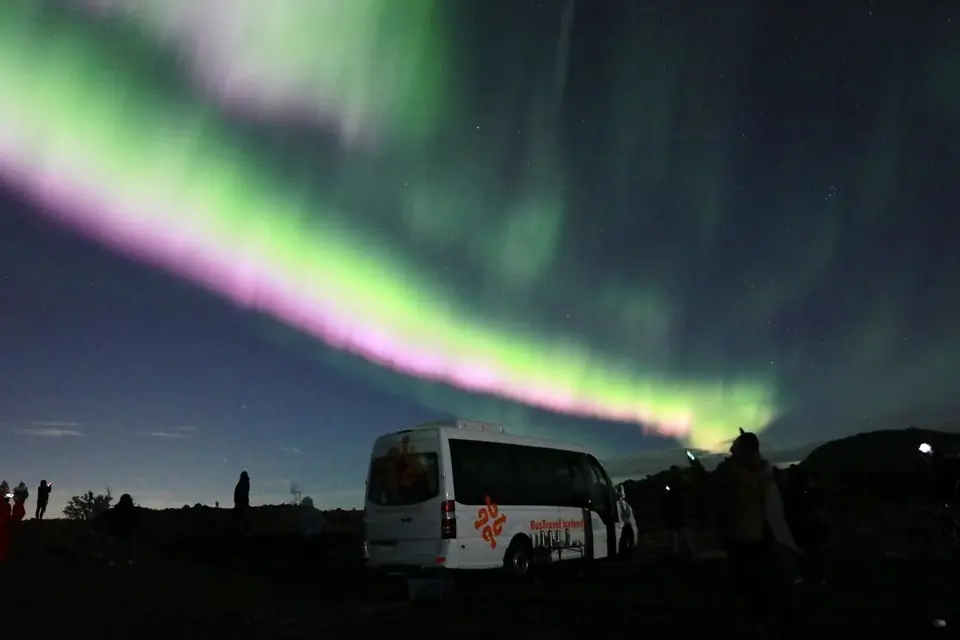
A good aurora forecast in Iceland is not a single number. It is a short stack of public maps: cloud cover, geomagnetic activity, and how dark the sky will be. People often start with the Kp index because it is easy to quote. In this country, start with the clouds.
We do not copy or scrape forecast maps onto this site. The offices that produce them already publish them clearly. This article shows you how to read those pages, then points you to them. For a shorter version, use our forecast page.
Start with cloud cover
If Iceland is under a thick, unbroken sheet of cloud, you will not see the lights, no matter how excited the solar wind is. The page to open first is the Icelandic Met Office cloud-cover forecast. Look at the night hours you will actually be outside, not only the late-afternoon picture.
You are hoping for a break, not necessarily a whole country of clear sky. A gap to the north or overhead can be enough. Cloud also moves. A forecast that looks poor at 18:00 can open at 22:00, which is one reason guided hunts leave town and then change direction. Wind can tear a layer open, and a new band can close it again an hour later.
Read the map for the region you can reach. If you are based in Reykjavík, the southwest and west are the first question; the south coast or Snæfellsnes only matter if the roads are open and you have time to get there. A clear patch in the Eastfjords is of no use if you are standing in the capital.
What the Kp index actually measures
Kp is a planetary index of geomagnetic activity, on a scale from 0 to 9, published by the NOAA Space Weather Prediction Center. It is a worldwide average, updated in three-hour blocks. It is not a local brightness meter for Reykjavík, and it is not a reservation.
Because Iceland lies under the auroral oval, a modest Kp can already be enough here on a dark, clear night. Around the capital, Kp 2 or 3 is often worth going out if the sky is clear. A higher reading, around Kp 5 and above, means a stronger storm. Those nights can be visible even with some moonlight, and sometimes from closer to town. They are still useless under solid cloud.
A low Kp with clear, dark sky beats a high Kp under cloud. That is the most common mistake visitors make: they cancel a clear night because the number looks small, or they drive out into fog because the number looks large.
NOAA also publishes a 30-minute aurora forecast, a map of where the oval is expected to be in the short term. It is a useful second check once you already know the cloud picture, not a substitute for it. The Icelandic Met Office aurora page puts the local view in one place and is the page we recommend opening alongside the cloud map.
Darkness, moonlight and the season
Activity and clear sky are not enough if the sky is bright. In June and July, Iceland is too light at night for a reliable display. The useful season is about September to mid-April, as we explain in best time and places. Around midwinter the sky is dark by late afternoon, so you have a longer window if the cloud is slow to break.
Moonlight is a softer problem than cloud. A full moon on snow can hide a faint arc and make the landscape very bright in photographs. A strong storm still shows. You do not need to stay indoors at full moon; you may just want a darker viewpoint and realistic expectations for a quiet night.
Civil and astronomical twilight times shift quickly in spring and autumn. In late August or late April a 22:00 departure can still be too bright. Check how dark it will be at the hour you go out, not only the date on your calendar.
How to put the three together
Each evening in season, read the sources in this order:
- Cloud cover on vedur.is for the hours after dark, in the region you can reach.
- The Icelandic Met Office aurora forecast, then NOAA’s Kp index and short-term oval map.
- Darkness and moonlight: is the sky actually dark, and will the moon be low or bright?
- Roads, if you are driving: road.is the same evening, and SafeTravel if you are leaving the main routes.
If the cloud is poor and staying poor, stay in. If the cloud is mixed and activity is modest, it can still be a good night — especially with a guide who can move. If the cloud is open and activity is high, leave town even if the moon is up.
Forecasts change. Look again after dinner, not only at breakfast. A tour operator will be doing the same thing: watching the cloud more closely than the headline Kp.
What a forecast cannot do
No official map can promise that the lights will appear over your hotel, your tour stop or your hired car. The aurora is a natural event. It can flare for twenty minutes and fade, or run for hours, or stay faint and low on the horizon. A “good” forecast is only a reason to go outside and give the sky some time.
If you join a guided tour, you are buying that time, a darker viewpoint and a driver who is used to reading these maps. If you prefer to go yourself, read guided tour versus self-drive before you plan the route. Either way, dress for a long, still stop in the wind — see what to wear and how to photograph the aurora.
Bookings on this site are not open yet. The forecast tools above are public and free, and they will still be the right tools when you go.
See all toursForecast guideSelf-drive guide